Pacific Salmon Treaty: conserving salmon while the margins shrink
A shorter version of this article by SkeenaWild Assistant Director Nathan Meakes appeared in the February 10, 2026 issue of the Vancouver Sun.
Pacific salmon don’t respect borders. They leave their natal rivers, spend years roaming the North Pacific, and return through a patchwork of fisheries managed by different governments, rules, and priorities. That mismatch—between a fish’s biology and our political boundaries—is the reason Canada and the United States built the Pacific Salmon Treaty in the first place, and why the next negotiation cycle carries real weight. That urgency is coming into focus, with the Pacific Salmon Commission’s annual meeting in Vancouver from February 9–13, where governments and technical experts take stock of run status and the effectiveness of current rules.
The Treaty was created to coordinate conservation and fisheries for salmon that migrate across the international boundary. It’s easy to talk about it as a sharing agreement, but its deeper purpose is conservation: ensuring enough fish survive the ocean and the fisheries to reach their spawning rivers, rebuild where needed, and sustain the long-term productivity of wild salmon populations, while prioritizing access for the countries of origin.
What’s different now is the context. We are negotiating for pieces of a smaller pie.
Across the coast, many salmon stocks are under sustained pressure from changing ocean conditions, warming rivers, degraded habitat, and cumulative fishing impacts. In that setting, allocation debates are no longer just about who gets what. They are increasingly about whether enough fish make it home at all, whether escapement targets can be met, whether weak stocks can rebuild, and whether the next generation will inherit resilient salmon runs or merely a memory of them.
The negotiation environment is also more complicated than it was in past decades. International relationships do not sit outside salmon policy; they shape it. Trade tensions, domestic political pressures, and regional priorities can harden positions and make compromise harder. Even when both countries share long-term interests, the incentive to chase short-term domestic wins rises when relationships are brittle, and fish are scarce. That is a risky combination: fewer fish, less flexibility, more politics.
A brief historical context
Canada and the United States have been trying to manage cross-border salmon issues since the early 20th century, as interceptions and mixed-stock fisheries expanded and science improved. With improved monitoring, it became clear that harvest practices were leading to diminishing returns and that competition over migrating stocks was contributing to a bleak future. The Pacific Salmon Treaty took effect in 1985 and, for a time, the institutions and arrangements it created provided a workable structure. But those original fishing arrangements expired in 1992, and the limits of the early framework became clear. For much of the 1990s—between 1992 and 1998—the two countries could not agree on comprehensive, coast-wide fishing arrangements.
A major reset came in 1999, when government-to-government negotiations restructured long-term fishing regimes and modernized the Treaty’s machinery. That period introduced new tools for managing border-crossing river systems and strengthened scientific cooperation, alongside a move toward abundance-based management that linked fishing rules more closely to the number of fish available. Subsequent ten-year agreements followed, with major updates recommended in 2008 and again in 2018. The current fishing regimes are in force from 2019 through 2028, with ongoing review of stock status and whether the rules are delivering conservation outcomes.
The conservation problem the Treaty must now face
In principle, a modern salmon agreement should do two things at once: reduce cross-border conflict and protect the long-term health of salmon runs. In practice, the Treaty has always been strongest at negotiating harvest sharing and fishing regimes, and weaker at addressing broader drivers of wild salmon decline that now shape survival coast-wide.
Several issues stand out because they amplify each other and because they are hardest to solve with a traditional “divide the harvest” approach.
Mixed-stock fisheries, non-selective impacts, and climate change
Salmon and steelhead aren’t particular about who they swim with; other species from other places often co-migrate. This results in many fisheries on this coast being mixed-stock: they catch salmon from multiple rivers and regions simultaneously, including both strong and weak populations. Within the Treaty’s conservation mandate, protecting salmon means protecting diversity. Across and within individual stocks, a run’s mix of life histories, timing, and habitats is what spreads risk, sustains productivity, and makes salmon resilient to changing dynamics. When fishing is non-selective, meaning it cannot reliably avoid endangered or depleted stocks, the conservation risk rises. Even if a fleet is aiming for healthier runs of fish, weak wild stocks can be swept up along the way. Climate change intensifies this problem by shifting migration timing, ocean distribution, and run composition in ways that make it harder to predict what’s in the water at any given time, and by increasing stress and mortality when fish are already struggling to survive warm rivers and changing ocean conditions. In a period of low abundance, a mixed-stock, non-selective harvest becomes more than a management headache, reducing fishing opportunities. It becomes a direct constraint on rebuilding because the fish that most need protection are often the hardest to separate in the water.
Counting Every Fish
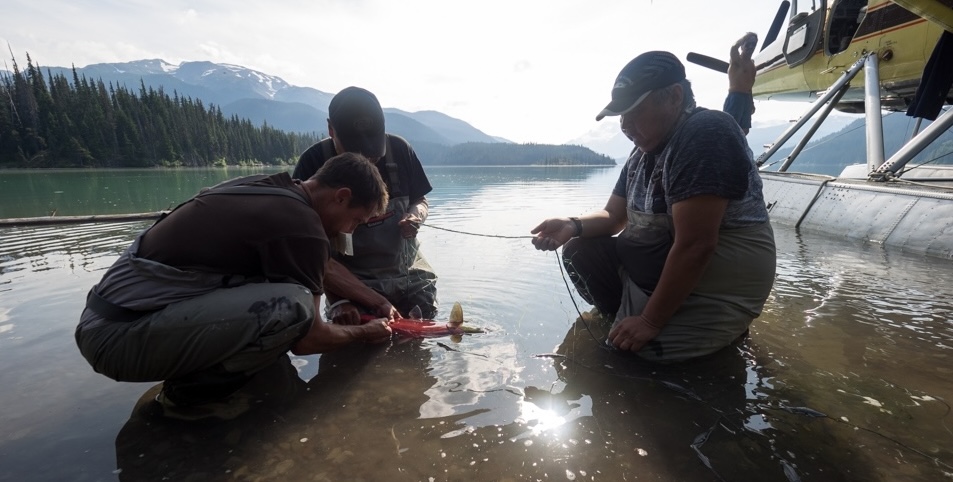
We can’t effectively manage what we don’t count. In a period of declining returns, conservation depends on counting every fish, not just the ones that land on a dock. That means treating data as a conservation tool: tracking steelhead even when they fall outside formal treaty structures; accounting for fish released under Fisheries-Related Incidental Mortality (FRIM) where “released” can still mean dead; and making discards visible instead of letting them disappear into paperwork. In mixed-stock fisheries, small uncounted losses can add up quickly across fleets, times, and places, especially when weak wild stocks are moving through alongside stronger runs. If the goal is rebuilding, then the standard must be simple and consistent: full accountability for total mortality, transparent reporting, and monitoring strong enough that conservation decisions are based on what actually happens in the water, not what is easiest to measure.
Hatchery overproduction and wild productivity
Small-scale conservation hatchery programs have legitimate roles, but the scale of hatchery production across the North Pacific creates a conservation challenge that is difficult to manage through the Treaty. Not only are they very expensive, but large hatchery releases also reduce wild fish productivity. There are limits to the system; food availability largely determines how many fish our oceans can support. Flooding the system with hatchery-raised salmon can blur the difference between apparent abundance and wild resilience. Hatchery decisions are largely made within domestic systems, while the consequences are felt across the shared ocean where wild fish from many watersheds mix. The Treaty can coordinate harvest and monitoring, but it is not well designed to set enforceable limits on hatchery production or address cumulative impacts on wild salmon productivity.
Steelhead outside the agreement
Steelhead, an ocean-migrating form of rainbow trout, shares migration corridors and many threats with salmon, but they are not included in the Pacific Salmon Treaty. That omission matters because it leaves no parallel, coast-wide binational framework to drive consistent cross-border conservation measures for steelhead. Where steelhead are incidentally caught in fisheries targeting other species, outcomes depend mostly on domestic rules and voluntary or ad hoc cooperation rather than shared treaty obligations designed to protect them.
Why is urgency justified?
There is a pressing need to ensure the Pacific Salmon Treaty operates with true accounting and accountability. It’s urgent because the margin has shrunk. Getting it right for fish on both sides of the border has never been more important.
When salmon are abundant, imperfect agreements can limp along. When salmon are scarce, the cost of delay and the effectiveness of conservation measures decline quickly. If the next agreement does not put conservation first, tightening overall impacts when returns are poor, reducing harm to depleted stocks in mixed-stock fisheries, and confronting the cumulative pressures that undermine wild productivity, “sharing” becomes a negotiation over decline.
At the same time, a fair agreement is not only about equity between countries. It is also about creating durable incentives to invest in recovery. Habitat protection, restoration, monitoring, enforcement, and community-led stewardship require long-term commitment. That commitment erodes when people believe their fish will not be allowed to rebuild at home, or when the rules do not meaningfully protect the most vulnerable stocks.
The Pacific Salmon Treaty exists because salmon cross borders, and because neither country can conserve them alone in a shared ocean. The question now is whether the next chapter of the Treaty can match the reality and the urgency on the water: fewer fish, more variability, and higher stakes. Negotiating for pieces of a smaller pie can either become a race to defend what remains or a slow-motion argument over who gets the last slice.
(Nathan Meakes is SkeenaWild’s Assistant Director)

Salmon monitoring matters
Follow us on social media to get the latest information.


Other News
-

Pacific Salmon Treaty: conserving salmon while the margins shrink
Pacific Salmon Treaty: conserving salmon while the margins shrink A shorter version of this article by SkeenaWild Assistant Director Nathan Meakes appeared in the February…
-
Canada losing track of salmon health as industrial pressures grow
Canada losing track of salmon health as industrial pressures grow New research shows that Canada is steadily losing its ability to monitor the health of…
-
2025: Our year in Review
2025 Annual Report 2025: What We Achieved Together And what’s in store for 2026. Your support makes it all happen. Together, we’re building a sustainable…
-
Citizen Letter to an MP — Uphold the North Coast Oil Tanker Moratorium
The North Coast of British Columbia is one of the most ecologically rich, culturally significant, and irreplaceable coastlines in Canada. Our salmon rivers, wildlife, forests,…
-
Pacific Salmon Treaty: conserving salmon while the margins shrink
Pacific Salmon Treaty: conserving salmon while the margins shrink A shorter version of this article by SkeenaWild Assistant Director Nathan Meakes appeared in the February…
-
Canada losing track of salmon health as industrial pressures grow
Canada losing track of salmon health as industrial pressures grow New research shows that Canada is steadily losing its ability to monitor the health of…
-
2025: Our year in Review
2025 Annual Report 2025: What We Achieved Together And what’s in store for 2026. Your support makes it all happen. Together, we’re building a sustainable…
-
Citizen Letter to an MP — Uphold the North Coast Oil Tanker Moratorium
The North Coast of British Columbia is one of the most ecologically rich, culturally significant, and irreplaceable coastlines in Canada. Our salmon rivers, wildlife, forests,…